The APAC food-tech sector is growing steadily as more attention turns to food security, healthier options, and sustainable production.
Governments across the region are supporting innovation, while startups are developing new ideas to meet changing needs in agriculture, nutrition, and processing.
In 2023, the food technology market in the region was valued at $60.82 billion. By 2034, it’s expected to climb past $170.22 billion, showing how much interest and funding the sector continues to attract.
Different countries are moving in different directions. Singapore is investing in research and lab-grown food. Australia is focusing on agri-based technology. India is witnessing an increase in startups exploring ways to enhance access, quality, and shelf life.
With continued support for research and stronger collaboration between public institutions and private companies, the Asia-Pacific food tech sector is steadily influencing how food is developed, produced, and delivered across the region.
APAC’s Food-Tech Ecosystem: A Hotbed for Innovation
Across the Asia-Pacific region, food technology is advancing through a combination of public support, private investment, and hands-on problem-solving.
Countries in the region are focusing on different areas, but they share a common goal: improving the way food is grown, produced, and delivered.
China is putting serious effort into cultured protein, with several companies working on lab-grown meat in Asia.
Singapore has become a hub for food-tech labs, where researchers and startups are developing cell-based seafood and fermentation-based ingredients. One of the most well-known examples is Shiok Meats, which is working to bring lab-grown shrimp and crab to market.
India has seen a steady rise in agri-tech startups that build tools for farmers, improve storage, and work on food science that supports nutrition and shelf life.
Japan and South Korea are also active in this space, with projects ranging from functional ingredients to modern fermentation techniques and packaging improvements.
Many of these efforts are supported by partnerships. Technology companies are working more closely with traditional food producers to test and apply new systems. These collaborations are helping to bring food technology innovations out of the lab and into real-world supply chains.
In 2024, agri-food tech startups in Asia-Pacific raised $4.2 billion in funding, a 38% increase over the previous year. This made up nearly one-third of global investment in the sector.
The scale of this activity shows how much trust investors and governments are placing in the region’s ability to solve long-term food challenges.
From large countries like China and India to smaller innovation hubs like Singapore, the Asia-Pacific food tech sector continues to grow through research, teamwork, and steady investment in the future of food.
APAC’s Game-Changing Food-Tech Startups
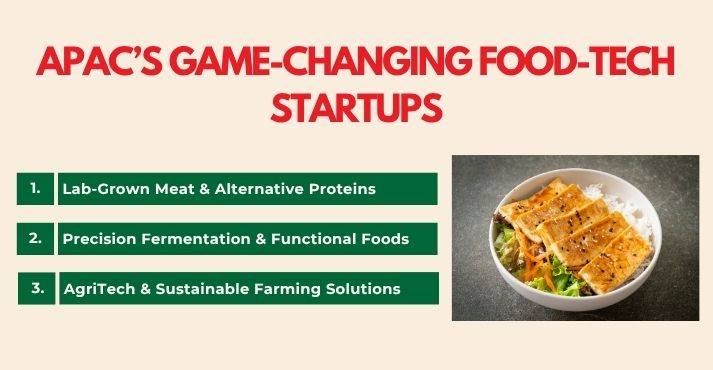
APAC food startups are finding new ways to solve problems in food production, health, and sustainability. Their work responds to local needs and demand throughout the Asia-Pacific region.
1. Lab‑Grown Meat and Alternative Proteins
In Singapore, Shiok Meats has been working on lab-grown meat, including shrimp and crab, since 2018.
The company secured $10 million in bridge funding from investors, including Woowa Brothers and CJ CheilJedang, bringing its total backing to over $30 million. Their goal is to scale up by opening a pilot production facility.
In both Hong Kong and Singapore, Eat Just markets its cultured chicken under the GOOD Meat brand.
In December 2020, Singapore became the first country in the world to grant regulatory approval for this product, following the Singapore Food Agency’s review of its safety as an ingredient in chicken bites served in restaurants.
Both startups are contributing to the alternative protein industry in APAC by bringing cell-based seafood and poultry to local markets and moving closer to wider acceptance.
2. Precision Fermentation and Functional Foods
The rise of precision fermentation is evident in startups that mimic dairy products or create novel ingredients. Australian company Eighth Day Foods uses fermentation with lupin beans to produce “Lupreme,” a plant-based protein suitable for Asian dishes.
This leap in plant-based food trends delivers texture and nutrition similar to meat while avoiding resource-heavy ingredients. These firms are using clean-label ingredients to develop functional foods that offer simple, nutrition-focused options for everyday meals.
3. AgriTech and Sustainable Farming Solutions
An increasing number of agri-tech startups in Japan, Thailand, and Singapore are building vertical farming and indoor-growing systems. These setups use controlled environments and sensor tech to reduce water and land use while delivering fresh produce year-round.
For example, Singapore’s Archisen operates one of the city’s largest indoor farms, growing leafy greens and herbs in controlled-environment facilities.
The company supplies local retailers, such as RedMart and FairPrice, as well as restaurants, enabling fresher produce with shorter transportation times and preserved quality.
Through these efforts, sustainable food technology is becoming a practical reality, helping ensure cleaner, more resilient crops even in densely populated cities.
The Role of Research and Innovation Labs in APAC’s Food-Tech Revolution
In Asia-Pacific, research labs and innovation centers are working to improve the production, processing, and packaging of food. These efforts are often built on cooperation between universities, public agencies, and private companies.
In Singapore, the Food Innovation Hub and the Temasek Life Sciences Laboratory (TLL) are two major centers focused on food tech.
TLL is part of projects focused on aquaculture, plant-based protein, and crop science. Its work supports Singapore’s goal to meet 30% of its nutritional needs locally by 2030.
The Food Innovation Hub brings together researchers and companies to accelerate product testing, reduce production costs, and support startups in scaling new food products.
In Japan, the RIKEN Center for Sustainable Resource Science is conducting studies on plant biology and stress-resistant crops. It also works on microbial solutions for food production.
These projects support long-term goals in sustainable food production in the APAC region by improving the cultivation and processing of raw materials.
China’s food science labs, including those affiliated with the Chinese Academy of Sciences, are exploring ways to enhance ingredient extraction, prolong shelf life, and develop new materials for sustainable packaging. These labs are part of national efforts that connect research with industrial food production.
Together, these efforts show how research centers are becoming an essential part of the APAC food ecosystem. By focusing on applied science and working closely with industry, they are helping turn early-stage research into real improvements in food systems.
How APAC’s Policies Are Accelerating Food-Tech Growth
Across the Asia-Pacific region, government policies are helping food-tech companies move forward. Through funding, clear regulations, and partnerships, public support is making it easier for startups and research groups to bring new ideas into use.
1. Singapore: A Global Leader in Food-Tech Policy
Singapore has laid out a clear path for food tech to grow. Its 30 by 30 goal aims to produce 30% of the country’s nutritional needs locally by 2030.
To support this, the government launched the Agri-Food Innovation Park, which brings together urban farming, food production, and technology under one roof.
Singapore was also the first country to approve the sale of cultivated meat, giving companies like Eat Just a legal route to enter the market. This type of Singapore food policy is providing food-tech startups with the clarity and support they need to operate and grow.
2. India’s Thriving AgriTech Policies
India has been actively supporting agri-tech startups, especially those focused on sustainable practices.
Government programs, such as the Agri-Infra Fund and Rashtriya Krishi Vikas Yojana, provide grants and low-interest loans to help startups invest in cold storage, logistics, and farm-tech systems.
India is also encouraging exports of processed food through infrastructure support and market access programs. These policy shifts in food technology are helping local companies build stronger supply chains and expand into international markets.
The focus on sustainability in agriculture is also growing, with funding for organic farming and traceability systems.
3. China’s Focus on Food Security & Innovation
China’s food-tech policy is closely tied to its focus on food security. The country has committed to stable grain output while also supporting innovation in protein production. Cultivated meat and plant-based food are part of its national plans.
In Beijing’s Fengtai district, a dedicated innovation base was launched in 2023 to support research and early-stage production of new protein products.
Government agencies are also collaborating with startups to develop safer ingredients, improved packaging, and innovative methods to enhance shelf life. These programs show how China is connecting long-term food supply needs with food-tech innovation.
APAC’s Food‑Tech Impact on Global Markets
Innovation in the Asia‑Pacific food ecosystem is beginning to influence what ends up on plates around the world. From cultivated proteins to sustainable supply chains, the region’s food-tech offerings are starting to affect global trends and trade.
Australian startup Vow recently gained approval from FSANZ to serve its lab-grown quail meat in restaurants. With this clearance, Vow can begin supplying gourmet establishments in Australia and has already served dishes in Singapore.
These milestones open the door for the expanded export of alternative proteins and pave the way for newcomers, such as cultured lamb or chicken.
Global food brands are forging partnerships with innovators to tap into food innovation in the APAC region. For example, Australian company V2food has been supplying plant-based burger patties to Burger King outlets in Japan and the Philippines.
The Plant-Based Whopper became a permanent menu item in the Philippines in late 2020 and was later introduced in Japan, showing that APAC-made alternatives can meet mainstream consumer preferences.
These developments show how Asia-Pacific is influencing global food systems, from securing export-ready cultured meat products to creating license agreements and supply deals.
The region’s focus on alternative proteins and sustainable food solutions is now a real factor in setting international trends.
Challenges in the APAC Food-Tech Revolution
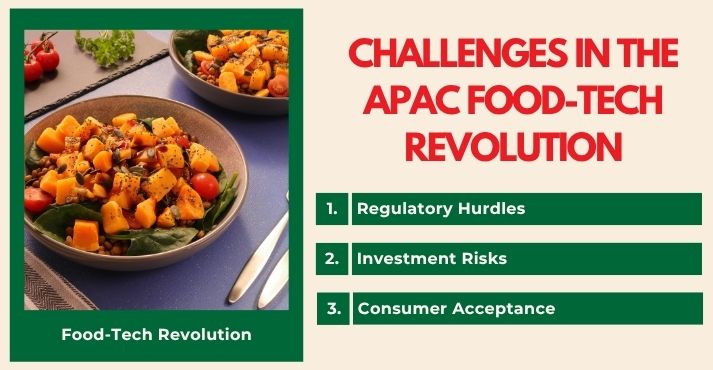
The food-tech sector in the Asia-Pacific region is expanding rapidly, but it still faces significant challenges. These include regulatory delays, funding gaps, and uncertainty around consumer response.
These issues affect startups, investors, and food manufacturers as they attempt to introduce new products to the market.
1. Regulatory Hurdles
Getting food-tech products approved is not always a straightforward process. Each country in the APAC region has its own process, and not all of them have clear guidelines for things like cultured meat or new plant-based ingredients.
This slows down launches and makes it harder to plan exports. Even large food companies face added costs when rules are unclear or change often.
2. Investment Risks
While some countries, such as Singapore, have strong funding support, others are still catching up. Deep-tech projects in food often take years to develop, which makes some investors cautious.
Startups require steady backing to establish labs, scale production, and recruit skilled teams. Inconsistent food-tech investment in APAC is one of the reasons why some promising companies struggle to grow.
3. Consumer Acceptance
Many people in the region remain uncertain about lab-grown meat and some plant-based foods. Concerns about safety, texture, or unfamiliar ingredients can deter interest.
Even when the product is approved and available, it may take time before it becomes part of everyday meals. Building trust and offering more choices will help move this forward.
The Future of APAC Food-Tech: What’s Next?
By 2030, food tech across the Asia-Pacific is expected to grow in areas such as alternative proteins, packaging, and farm technology. Countries in the region are making steady progress in improving the production, storage, and delivery of food.
Plant-based protein is one area set to expand further. Startups are working on making meat alternatives taste better, last longer, and cost less.
These products are already appearing in grocery stores and fast-food chains, with more options expected to enter the market as demand increases.
Smart farming in APAC is also becoming more common. Farmers are using sensors, climate controls, and data tools to grow food more efficiently.
This is especially helpful in cities or areas with limited farmland, where indoor or vertical farms can help reduce pressure on land and water resources.
Automation is starting to support food production at larger scales. Machines that handle sorting, packing, and safety checks are helping manufacturers lower waste and improve consistency.
With increased government funding and updated food regulations, food-tech will likely continue to transition from small pilots to everyday use across the region.
Conclusion
Asia Pacific is becoming an important region to watch in food tech. Government programs, local demand, and startup activity are all helping new ideas move from the lab to the market.
Whether it is plant-based foods, smart farming, or improved packaging, the region is finding practical ways to enhance the production and delivery of food.
As more support is provided for research and production, this space is likely to continue growing. For anyone involved in the food industry, whether as an investor, company, or policymaker, it is worth staying updated on what is happening in the Asia Pacific.
The region is taking steady steps toward food systems that are more efficient, safe, and sustainable, and the rest of the world is paying attention.